> For the complete documentation index, see [llms.txt](https://kiakilipictures.gitbook.io/wallet-monsters/llms.txt). Markdown versions of documentation pages are available by appending `.md` to page URLs; this page is available as [Markdown](https://kiakilipictures.gitbook.io/wallet-monsters/the-basics/tokens-and-tokenomics.md).
# Tokens & Tokenomics
Contract Tokens: UUJI, eATK, eDEF, Elixers, & Potions
While $Enjimon are ERC721 NFTs, all other assets from UUJI to eATK artifacts are fungible tokens known as ERC1155.
## UUJI
UUJI is the native asset that powers the Wallet Monster Protocol and can be used throughout the Wallet Monster Metaverse. UUJI are ancient $Enjimon relics and are required when performing various interactions between Trainers and $Enjimon. UUJI is deflationary, and every interaction involves the consumption of UUJI, effectively burning the consumed portion.
{% hint style="info" %}
UUJI tokens are hard-capped at 100Million UUJI total token supply.
{% endhint %}
When UUJI is given to an $Enjimon it consumes a portion sent destroying it forever, while the remainder is escrowed to the $Enjimon only to be released once the $Enjimon has been slain (**see $Enjimon Poachers section**)
## eATK
eATK comprises 1/4 cosmic stardust from a Supreme Being type $Enjimon, 1/4 Vitalic serum, and 2/4 ancient $Enjimon relic.
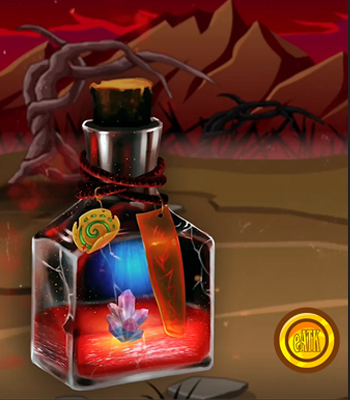
eATK potions have unique attributes when given to an $Enjimon, increasing its attack power. eATK are uncommon potions that can be purchased with UUJI from any Pop-Up Trainer Shop.
{% hint style="info" %}
All ERC1155 tokens in the Wallet Monsters contract are deflationary and are destroyed upon consumption. Certain tokens like eATK & eDEF can be minted by Trainers
{% endhint %}
### eDEF
eDEF comprises 1/3 cosmic stardust from a Supreme Being type $Enjimon and 2/3 ancient $Enjimon relic.

eDEF potions have unique attributes when given to an $Enjimon, increasing its defense level. eDEF are uncommon potions that can be purchased with UUJI from any Pop-Up Trainer Shop.
{% hint style="info" %}
All ERC1155 tokens in the Wallet Monsters contract are deflationary and are destroyed upon consumption. Certain tokens like eATK & eDEF can be minted by Trainers
{% endhint %}
### HP Potions
Potions comprise 1/4 cosmic stardust from a Supreme Being type $Enjimon and 3/4 $Enjimon relic.

When given to an $Enjimon, Potions have unique attributes, increasing and replenishing the $Enjimons Health Points (HP). HP Potions are rare and can not be purchased from the Wallet Monsters protocol, although they may be found in the marketplace if an owner chooses to sell them.
{% hint style="info" %}
HP potions are reserved for community events and in-game rewards, with the total supply hard capped to initial mint value.
{% endhint %}
### Elixer Crystals
Elixer crystals are pure cosmic stardust from a Supreme Being type $Enjimon.

When given to an $Enjimon, Elixers have unique attributes, increasing the $Enjimons level and all of its attribute values. Elixer crystals are rare and can not be purchased from the Wallet Monsters protocol, although they may be found in the marketplace if an owner chooses to sell them.
{% hint style="info" %} Elixer crystals are reserved for community events and in-game rewards, with the total supply hard capped to initial mint value.
{% endhint %}
## Tokenomics
Tokenomics is a neologism that combines the words Token and Economics. As defined by The Suns Of DeFi -"Tokenomics is the quality of a token that convinces users or investors to adopt it, helping to build an ecosystem around the project for that token." Anything that impacts the token's value falls within the category of tokenomics.
{% hint style="success" %}
The Wallet Monsters protocol is decentralized, requires very little capital to scale, and offers significant transaction security.
{% endhint %}
### What is a Token?
#### Tokens in the real world
A token is a tangible representation of a fact, quality, or feeling in the analog world. Think gym memberships or reward card points. Your gym membership is a factual representation of your subscription to the local gym.
#### Tokens In the Metaverse
A token represents "something" within the protocols ecosystem in the crypto metaverse. For example, $Enjimon are Non-Fungible Tokens representing the living escrow-able digital assets. While fungible tokens like UUJI represent in-DApp/Metaverse currency and eATK, eDEF, Potions, and Elixers represent in-DApp utility items that produce various effects.
As you can see, a Token can represent value, stake, voting rights, or anything developers can imagine. It's important to note that a token is not limited to solely one specific role and can fulfill many functions within its native ecosystem.
{% hint style="info" %}
UUJI tokens function as in-DApp/Metaverse currency, as well as food for $Enjimon, and a source of power (TUE).
{% endhint %}
### Layer 1 vs Layer 2
#### Layer 1
* ***Layer 1*** is the underlying asset that powers the main blockchain (i.e. ETH and The Ethereum Blockchain).
* ***Layer 2*** is the DApp built on top of the main underlying blockchain.
For example, Ethereum users utilizing the Wallet Monsters DApp. Ethereum is the native asset that powers the Ethereum blockchain and is required to cover all transaction fees known as Gas. Polygon/Matic is a Layer 2 solution built on the Ethereum Blockchain designed for fast transactions, cheap gas fees, and large transaction volume. Although the Wallet Monsters Protocol's deployed across various chains (*Binance Smart Chain, Aavanche Network with more **coming soon***), the protocol (in our example) is built on top of the Ethereum Blockchain, using the Layer 2 solution Polygon. While **Matic tokens are required to cover gas fees for any transaction you do within the protocol on the Matic network, the UUJI token is the native asset of the Wallet Monsters Protocol and is required for nearly all transactions from $Enjimon interactions to buying from the Marketplace**.
{% hint style="warning" %}
Any issues that affect the layer 1 blockchain is going to affect the layer 2 solution
{% endhint %}
### Utility vs Security
If the ICO (*Initial Coin Offering*) is an investment opportunity in the protocol itself, then more than likely, it qualifies as a security. However, if the token doesn't meet the ["Howey Test"](https://www.sec.gov/corpfin/framework-investment-contract-analysis-digital-assets) qualifications, it is classified as a utility token.
{% hint style="info" %}
The Howey Test refers to **the U.S. Supreme Court case for determining whether a transaction qualifies as an "investment contract**," and therefore would be considered a security and subject to disclosure and registration requirements under the Securities Act of 1933 and the Securities Exchange Act of 1934.
{% endhint %}
Utility tokens provide users with a product and or service required to access whichever protocol ecosystem it derives. General utility tokens have the following properties:
1. Grants holders the right to use protocol
2. Allows holders to take advantage of the network by voting
3. Because there tends to be a cap on maximum availability on token supply, the price of tokens may go up due to the laws of supply and demand.
Additionally, because of the continued development of the space some tokens may have additional properties:
1. Rights: tokens may give the holder property or access rights
2. Durability: tokens can remain stable in the face of censorship and attacks
3. Regulatory: tokens are easy to classify and regulate (if required)
4. Purpose: tokens are created to serve as proof of behavior (value creation) or represent existing assets or access rights
5. Supply: there may be a fixed supply of tokens or unlimited
6. Token-flow: tokens can be generated linearly (destroyed after use) or remain in circulation
7. Temporal: tokens may or may not have an expiration date
#### Wallet Monster Tokenomics
The native asset UUJI grants holders the right to use the protocol. The Wallet Monsters team has purchased various [unstoppable domains](https://unstoppabledomains.com/) for the main DApp ([WalletMonsters.NFT](https://walletmonsters.NFT)). Including additional Unstoppable Domains for interoperable standalone DApps that extend the core metaverse. Both on the Ethereum & Polygon Networks, providing **enhanced durability against censorship**. The UUJI tokens are used as a source of food to feed $Enjimon, stamina for training $Enjimon, energy when escrowed to $Enjimon, and in DApp purchases from the Pop-up Trainer Mart. eATK, eDEF, HP Potions, and Elixers are attribute enhancements to make a Trainers $Enjimon even more powerful. UUJI, Potions, and Elixer tokens have a hard-capped token supply of 100 Million tokens. While eATK & eDEF have an initial mint supply of 100 Million and can be minted by trainers who purchase them with UUJIs via the Pop-Up Trainer Mart. All of the ERC1155 fungible tokens (UUJI, eATK, eDEF, Potions, and Elixers) are generated linearly and destroyed after use (**UUJI**** partially**) and **do not remain in circulation**, **nor do they have an expiration date**.
#### Utility
All interactions with $Enjimon require a certain amount of UUJI to satisfy the functionality of the protocol in addition to the network native asset to cover transactional gas fees (ie. Polygon Network fees are paid in Matic Tokens, Ethereum gas fees are paid in ETH). Most interaction that requires UUJIs have a variable matrix to determine UUJI cost for each specific exchange that is composed of two constants (base fees A & B) and a variable determined by the Trainers $Enjimon current level.
**Base Fee A** is divided in half, burning one portion and escrowing the other to the $Enjimon. **Base B** plus its variable are sent to *protocol reserves*. The combination of Base Fee A and Base fee B is the total amount of UUJI needed to execute interaction.

This behavior is found throughout the metaverse engagement while some omit the Base fee B transfer to protocol reserve all together and burning total fee. However, in the case of Marketplace sales, the UUJI fee is hardcoded to 10 tokens and its matrix burns three tokens and transfers the remainder to the seller.
Holders of $Enjimon NFTs need to have UUJI tokens on hand to prevent the onslaught of Immutable Death. $Enjimon allowed to starve will die, when $Enjmon are first minted they need daily care like babies. With time as your $Enjimon grows it will require to be fed less and less until it is going weeks at a time without required interactions. This is only achieved through the leveling up $Enjimon which increases its *Endurance* attribute.
{% hint style="info" %}
Outside of training your $Enjimon the only way to increase all of its attributes at once is to offer your $Enjimon a rare Elixer crystal
{% endhint %}
Thus $Enjimon Trainers are incentivized to level up their $Enjimon as a hedge against immutable death ($Enjimon require 8 hours of rest after each training session). On the flip side because of the deflationary nature of the interaction mechanics combined with the aspect that $Enjimon needs UUJI to survive incentivizes Trainers to become $Enjimon Traders purchasing $Enjimon from the marketplace with high TUE values only to raise them for slaughter when circulating supply runs low, granting them the title and rank of $Enjimon Poacher.